
Tangipahoa Parish Court Records After Arrest
After a Tangipahoa Parish arrest, the jail roster shows the booking side of the event. It may list the arresting agency, inmate ID, booking date, charge text, bond pending language, dollar bond amounts, and hold flags. The court side begins when the case moves through the 21st Judicial District Attorney and the 21st Judicial District Court. The 21st JDC has jurisdiction over Livingston, St. Helena, and Tangipahoa Parishes, and the Tangipahoa courthouse is at 110 North Bay Street in Amite.
The court record is not the same as the booking record. Booking detail belongs with Tangipahoa Parish jail inmate records, while booking photos are covered on the Tangipahoa Parish jail mugshots page. Court records after a jail arrest focus on the charges accepted or filed by the prosecutor, the case number, hearing activity, bond orders, warrant history, dispositions, and copy access through the clerk.
Search Tangipahoa Parish Court Records
The Tangipahoa Parish Clerk of Court provides criminal case access through its Criminal Record eSearch page, which links to Clerk Connect. The clerk states that criminal information goes back to 1901, traffic information goes back to 1974, criminal images are available back to January 2007, and details before the 1980s may be incomplete. The online service requires a subscription or login for full use.
- Gather the booking name, DOB, booking date, arresting agency, and charge wording from the jail roster.
- Open the clerk's Criminal Record eSearch page and follow the Clerk Connect criminal inquiry route.
- Search by defendant name, or by case number if one is already known from court paperwork.
- Open the case record and compare the formal charge list with the jail roster's booking charges.
- Check the status, minutes, image availability, and copy options before relying on a result.
The Clerk eSearch screenshot below comes from the Tangipahoa Clerk Criminal Record eSearch page and shows the paid access model and record coverage.
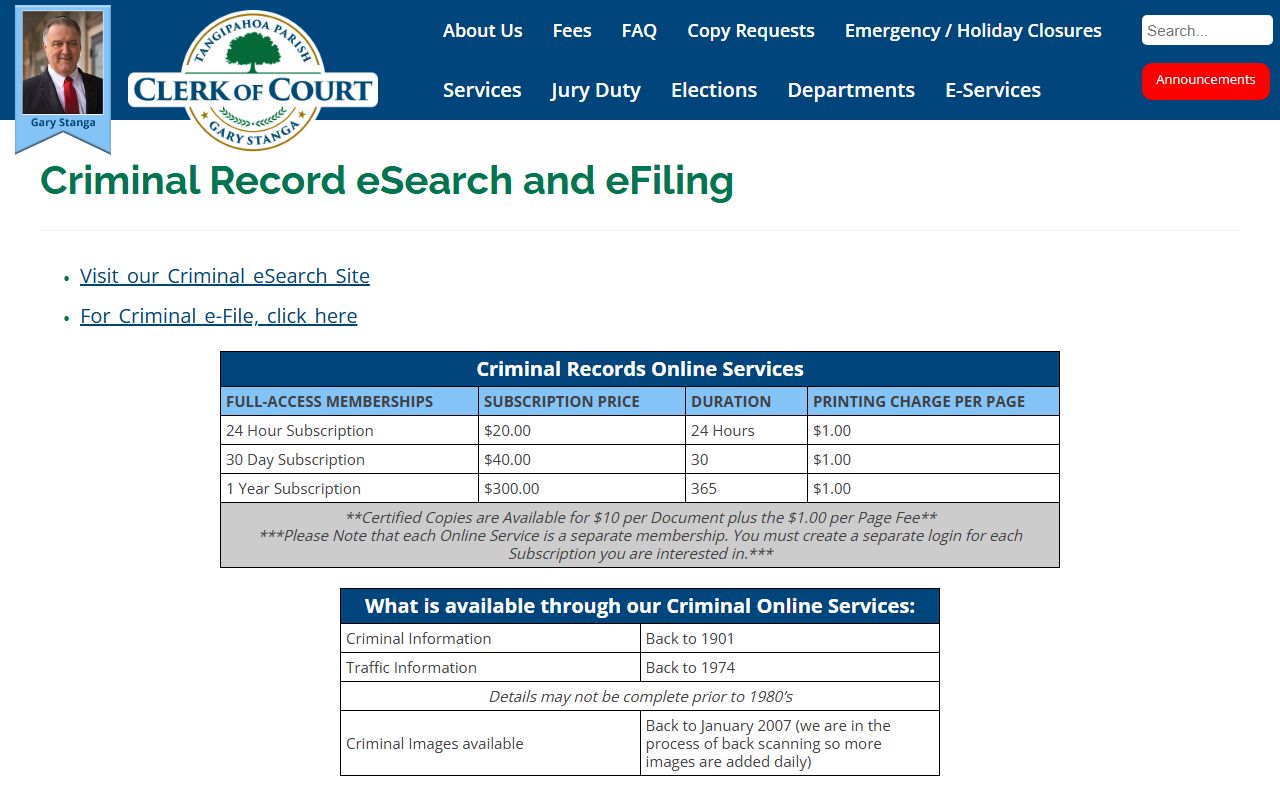
The screenshot matters because court records after an arrest are not searched in the jail roster once the formal case has opened.
Tangipahoa Parish Court Record Fees
The clerk's published fee structure is specific. A full-access online membership is $20 for 24 hours, $40 for 30 days, or $300 for one year. Printing costs $1 per page. Certified copies cost $10 per document plus $1 per page. If a user calls the office to verify information obtained through Criminal Record eSearch, the clerk lists a $20 Criminal History Search Fee.
| Item | Amount | Use |
|---|---|---|
| 24-hour membership | $20 | Short online case-search access. |
| 30-day membership | $40 | Temporary broader online access. |
| 1-year membership | $300 | Longer-term online access. |
| Printing | $1 per page | Printed online records. |
| Certified copies | $10 per document plus $1 per page | Official copy requests. |
| Office verification | $20 | Criminal History Search Fee for office verification. |
Charges After Tangipahoa Parish Arrest
Jail charges can change after review. The 21st Judicial District Attorney decides what to accept, amend, reduce, dismiss, or prosecute. Scott M. Perrilloux is the district attorney for the 21st Judicial District, and the district attorney's office states that the district includes the DA, 23 assistant district attorneys, and support staff. The Tangipahoa office is in the courthouse in Amite.
| Document | Filed By | What It Does |
|---|---|---|
| Complaint | Law enforcement or prosecutor | Starts or supports a criminal accusation after arrest. |
| Bill of information | Prosecutor | Formal charging document commonly used by the DA. |
| Indictment | Grand jury | Formal charge returned by a grand jury, often for serious felonies. |
The 21st JDC screenshot below comes from the 21st Judicial District Court, the court with jurisdiction over Tangipahoa Parish criminal cases.
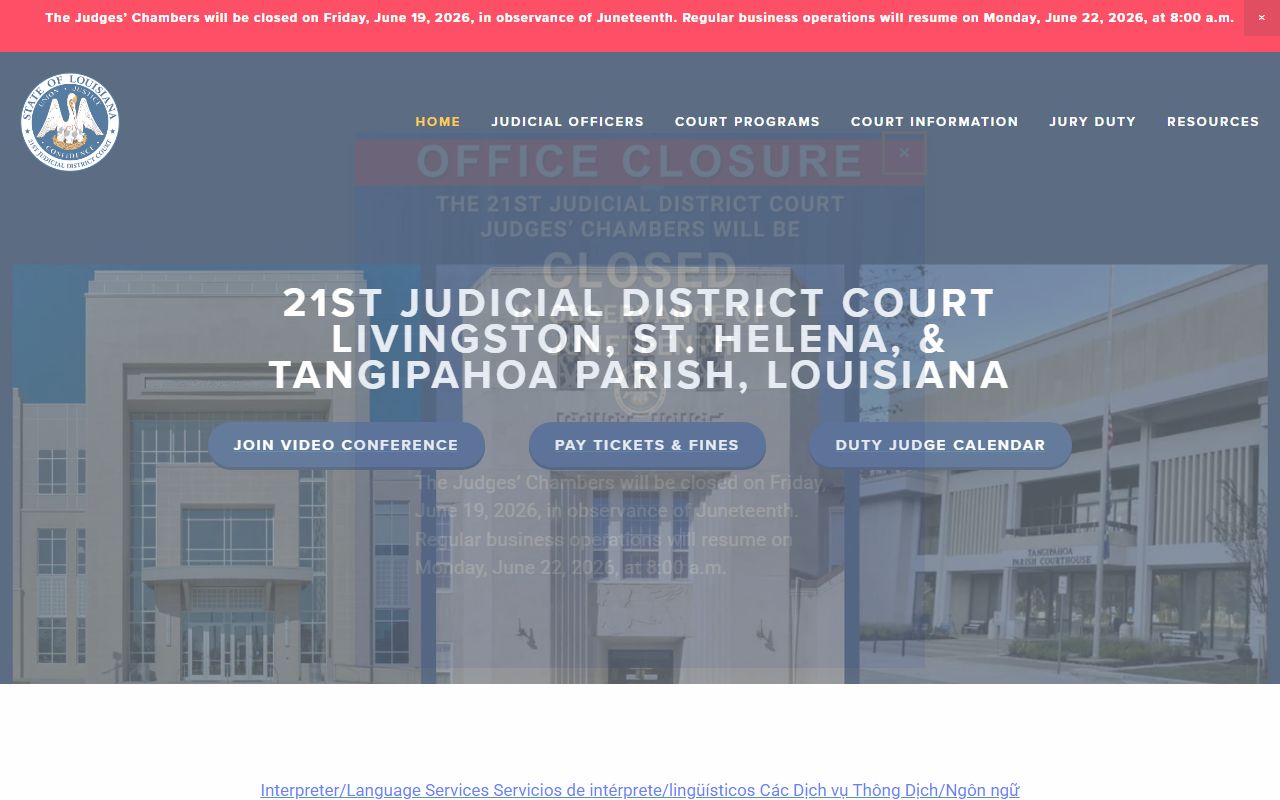
The court page confirms that court records after an arrest are handled in a district system that also serves Livingston and St. Helena Parishes.
Tangipahoa Parish Charge Status
A court case can move through several status changes after a jail arrest. Pending means the case or charge has not been resolved. Amended or reduced means the charge wording or level changed after review or negotiation. Dismissed means a charge was dropped by court action. Nolle prosequi, often shortened to nolle pros, means the prosecutor declined to continue a charge. A disposition is the result of a charge, such as dismissal, plea, verdict, or other final action.
| Status | What It Means |
|---|---|
| Pending | The charge or case is still active and unresolved. |
| Amended | The charge text or legal basis changed after filing. |
| Reduced | The charge was lowered to a lesser offense or level. |
| Dismissed | The charge was dropped by the court or prosecutor. |
| Nolle prosequi | The prosecutor chose not to proceed on that charge. |
| Convicted | The person was found guilty or entered a guilty plea. |
Bond After Tangipahoa Parish Arrest
Tangipahoa Parish jail profiles show bond at the charge level. Some records may say Bond Pending, while others show dollar amounts. A listed amount does not always mean release is available, because a fugitive hold, DOC hold, judge hold, warrant, probation or parole hold, federal/USMS hold, or ICE detainer can block release. A detainer is a request or hold from another agency. A no-bond hold means the person cannot be released by posting ordinary bond until the court or holding agency acts.
| Bond Type | How It Works |
|---|---|
| Cash bond | Cash is posted as security for court appearance. |
| Surety bond | A licensed bond agent guarantees appearance under a bail undertaking. |
| PR bond | Release on the person's promise to appear, without full cash deposit. |
| Bond pending | The public roster does not yet show a final bond amount. |
| No-bond or hold | Release is blocked until judge or agency action changes custody status. |
Warrants and Court Records
No official TPSO active warrant search page was located in the reviewed sources. A warrant issue may still appear indirectly after an arrest through the jail roster, court case record, bench warrant history, bond orders, or hold language. A bench warrant often follows failure to appear or a court order. A fugitive warrant or fugitive hold means another jurisdiction may want the person. A search warrant authorizes a search, not a jail booking by itself.
For warrant-related court records after a jail arrest, check the 21st JDC and clerk records for case status and court dates. Municipal matters in Amite, Hammond, Ponchatoula, Independence, Kentwood, Roseland, Tangipahoa, or Tickfaw may begin locally and may not appear as a public TPSO warrant list. For releasable booking, warrant, or incident material not online, use TPSO NextRequest. Active investigations, sealed records, and juvenile records can be withheld.
Charges Versus Convictions
An arrest and a charge are accusations or case events. A conviction is a final finding of guilt or a guilty plea. This distinction is important because Tangipahoa Parish court records after a jail arrest may show filed charges that were later reduced, dismissed, or resolved without conviction. The Louisiana State Police BCII page also states that Louisiana is a closed-record state for LACCH criminal history, with release limited to authorized entities.
| Point | Charge | Conviction |
|---|---|---|
| Stage | Accusation filed or booked. | Final guilty result by plea or verdict. |
| Proof | Based on probable cause or prosecution filing. | Requires proof beyond a reasonable doubt or a plea. |
| Record meaning | Shows what was alleged. | Shows a final criminal judgment. |
| Can change | May be amended, reduced, or dismissed. | May be appealed, vacated, pardoned, or expunged if eligible. |
Sealed and Expunged Records
Louisiana public-record access is broad under La. R.S. 44:31 and La. R.S. 44:32, but criminal records can be restricted by other laws. La. C.Cr.P. art. 971 provides legislative findings for expungement, which is the legal process that limits public access after qualifying outcomes. Juvenile matters, sealed filings, ongoing investigations, and some dismissed matters may not be available through routine public channels.
| Point | Sealed | Expunged |
|---|---|---|
| Public view | Hidden or limited by court order. | Removed from ordinary public access if granted. |
| Legal path | Requires statute or court action. | Requires eligibility and court process. |
| Effect | Restricts access to the court record. | Limits public access after a qualifying disposition. |
| Limits | Some agencies may retain restricted access. | Not every arrest, charge, or conviction qualifies. |
Important: Casual court lookup is not an FCRA-compliant background check and should not be used for employment, housing, credit, or insurance screening.